How to Study for Bank Exams: Complete Preparation Guide for 2026

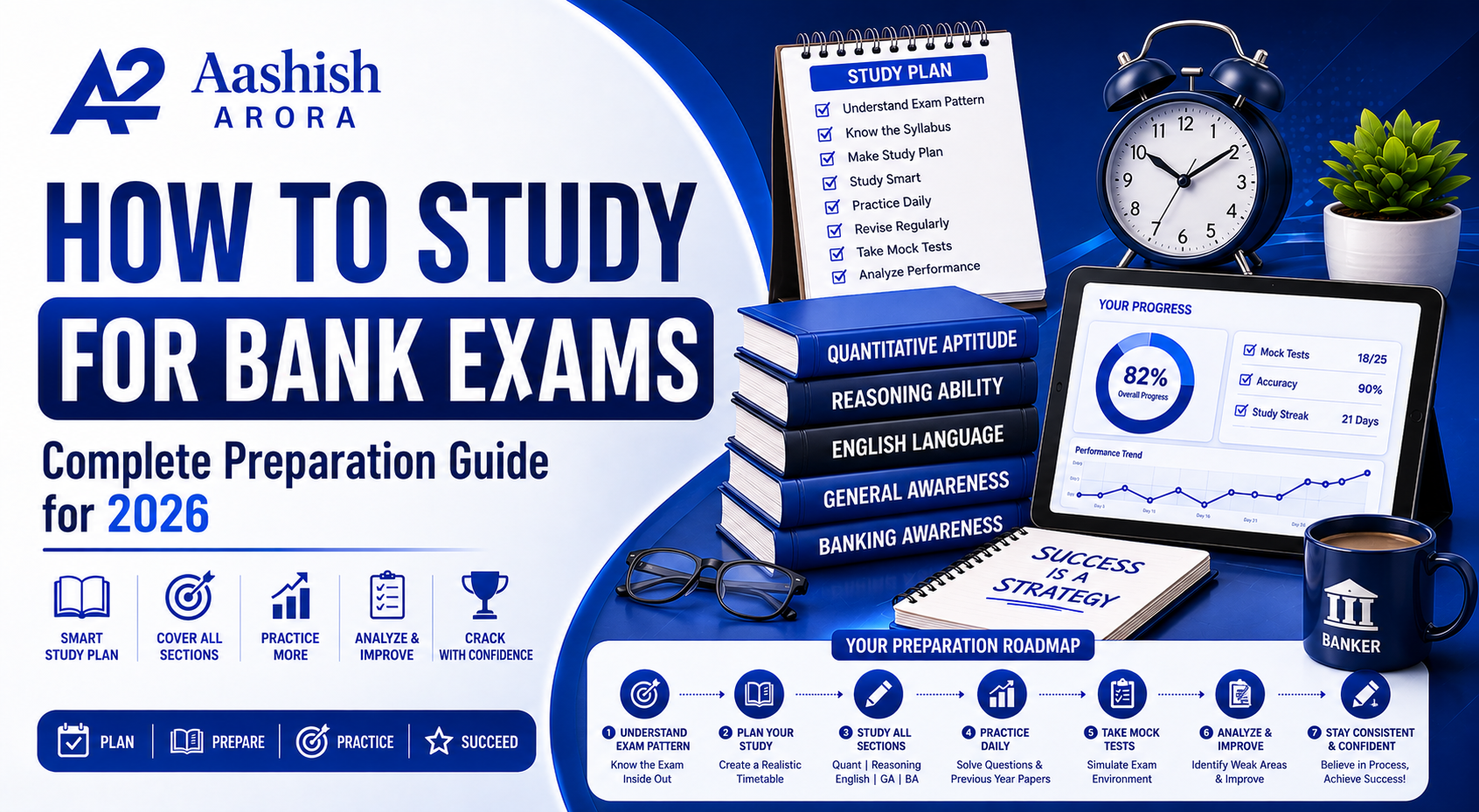
Banking exams in India continue to be one of the most competitive career pathways for graduates. With exams like IBPS PO, SBI PO, Clerk, and RBI Grade B attracting lakhs of aspirants every year, cracking them requires more than just hard work. It demands a smart strategy, consistency, and a well-structured approach.
If you are wondering how to study for bank exams effectively in 2026, this guide will walk you through a practical, result-oriented roadmap. From building concepts to creating a powerful bank exam study plan, everything you need is covered here.
Understanding the Bank Exam Structure
Before diving into preparation, it is important to understand the exam pattern. Most banking exams are conducted in two stages:
- Preliminary Exam: Includes Quantitative Aptitude, Reasoning Ability, and English Language
- Mains Exam: Includes advanced Quant, Reasoning, English, General Awareness, and sometimes Computer Knowledge
Each section has a time limit, which makes speed and accuracy equally important.
How to Study for Bank Exams: Step-by-Step Approach
Preparing without a plan often leads to confusion and burnout. Let’s break down a clear step-by-step approach that answers the most important question: how to study for bank exams in a structured and effective way.
1. Start with Concept Clarity
The first step is to build strong fundamentals. Many aspirants make the mistake of directly jumping into mock tests without understanding the basics.
Focus on:
- Arithmetic concepts like percentages, ratios, averages
- Basic grammar rules for English
- Logical reasoning fundamentals
When your concepts are clear, solving complex questions becomes much easier.
2. Create a Realistic Bank Exam Study Plan
A well-structured bank exam study plan is the backbone of your preparation. Without a plan, even the best resources can go to waste.
Here is a simple daily plan you can follow:
- 1 hour: Quantitative Aptitude
- 1 hour: Reasoning Ability
- 45 minutes: English Language
- 30 minutes: General Awareness
- 30 minutes: Practice or revision
Make sure your plan is realistic and flexible. Consistency matters more than intensity.
3. Focus on High-Weightage Topics
Not all topics carry equal weight in the exam. Prioritize topics that are frequently asked.
For Quant:
- Data Interpretation
- Arithmetic (Profit and Loss, Time and Work, Speed and Distance)
For Reasoning:
- Puzzles and Seating Arrangement
- Syllogism and Inequality
For English:
- Reading Comprehension
- Cloze Test
- Error Detection
This targeted approach will improve your efficiency.
4. Practice Daily with a Purpose
If you are serious about learning how to study for bank exams, you need to understand that practice is non-negotiable.
- Solve topic-wise questions daily
- Gradually increase difficulty level
- Maintain a notebook of mistakes
- Revisit weak areas regularly
Practice is what transforms concepts into exam-ready skills.
5. Attempt Mock Tests Regularly
Mock tests are a crucial part of any bank exam study plan. They help you simulate the real exam environment and improve time management.
Start with:
- 2 to 3 mocks per week (beginner phase)
- Increase to daily mocks (closer to exam)
After each mock:
- Analyze your mistakes
- Identify weak sections
- Work on time management
Without analysis, mock tests lose their value.
6. Improve Speed and Accuracy
Bank exams are all about solving maximum questions in limited time.
To improve speed:
- Practice mental calculations
- Learn approximation techniques
- Avoid lengthy methods
To improve accuracy:
- Focus on concept clarity
- Avoid guesswork
- Double-check calculations
Balancing speed and accuracy is key to success.
7. Strengthen General Awareness
General Awareness plays a major role in mains exams and can significantly boost your score.
Focus on:
- Current affairs (last 4 to 6 months)
- Banking and financial awareness
- Static GK
Make it a habit to spend at least 20 to 30 minutes daily on this section.
8. Revise Regularly
Revision is often ignored but is one of the most important aspects of preparation.
- Revise formulas weekly
- Go through previous mistakes
- Reattempt difficult questions
A strong revision strategy ensures better retention and reduces exam-day stress.
Common Mistakes to Avoid
While learning how to study for bank exams, avoiding common mistakes can save you a lot of time and effort.
Ignoring basics
Many aspirants skip fundamentals and struggle later with advanced questions.
Lack of consistency
Irregular study patterns slow down progress.
Overloading resources
Using too many books or courses leads to confusion.
Not analyzing mocks
This is one of the biggest mistakes. Analysis is where real improvement happens.
Fear of difficult questions
Avoiding tough questions limits growth. Try to understand them instead.
Weekly Bank Exam Study Plan
To make your preparation more structured, here is a sample weekly bank exam study plan:
Monday to Friday
- Focus on concept building and practice
- Cover 2 to 3 topics per week
- Attempt sectional tests
Saturday
- Take a full-length mock test
- Analyze performance
Sunday
- Revise all topics covered during the week
- Practice weak areas
This cycle helps maintain consistency and ensures continuous improvement.
Tips for Working Professionals and Students
If you are managing studies along with a job or college, your strategy needs to be more focused.
- Study 2 to 3 hours daily on weekdays
- Utilize weekends for longer study sessions
- Focus on high-impact topics
- Use short notes for quick revision
Even with limited time, a smart approach can yield great results.
Best Resources for Preparation
Choosing the right resources is crucial for effective preparation.
You can rely on:
- Standard Quant and Reasoning books
- Online mock test platforms
- Current affairs apps or PDFs
- Previous year question papers
Avoid switching resources frequently. Stick to a few quality materials and revise them thoroughly.
Staying Motivated Throughout the Journey
Preparation for banking exams can be long and challenging. Staying motivated is important.
- Set small, achievable goals
- Track your progress
- Celebrate small wins
- Stay connected with positive peers
Remember, consistency over months leads to success.
Final Thoughts
Understanding how to study for bank exams is not just about studying harder, but studying smarter. A clear strategy, consistent effort, and a well-planned bank exam study plan can make a huge difference in your preparation.
Focus on:
- Strong fundamentals
- Regular practice
- Mock test analysis
- Continuous revision
Every aspirant starts somewhere. What matters is staying consistent and trusting the process.
If you follow the right approach and remain disciplined, cracking banking exams in 2026 is absolutely achievable.
Recommended for you
Best books for bank exam preparation 2026: SBI PO, IBPS PO and Clerk

Top Reasons Students Prefer Aashish Arora for Banking Exams